Picture a Tuesday evening in July. The kids are playing outside, dinner’s on the grill, and nobody’s rushing back indoors once the sun starts to dip. That’s the backyard Ontario homeowners are actually building for these days, and it’s not a small trend. As per the news, 79% of Canadian yard owners now say their outdoor space feels like a genuine extension of their home, not just the part of the property between the house and the fence.
Compare that to what decks used to be, a flat rectangle of pressure-treated wood, a barbecue, maybe a couple of folding chairs dragged out for the season. That’s not cutting it anymore. Homeowners want dining zones, somewhere to actually lounge, lighting for after dark, and materials that won’t warp or crack the first time an Ontario winter really tests them.
Some of this is about value, the kind you feel every evening out there and the kind that shows up when it’s time to sell, with 92% of Canadians believing a yard increases the value of the home. Whereas some of it’s just climate reality, freeze-thaw cycles are hard on cheap materials, and plenty of homeowners have already paid to learn that lesson once.
This guide is all you need to read when it comes to what’s actually trending in Ontario backyards. We’ll also walk through why yards are sticking around and how to figure out which trend genuinely fits your yard.
Trend #1: Multi-Level Decks That Create Functional Outdoor Zones
Here’s the thing about a single flat deck: it works great for one activity at a time, and falls apart the second you’re trying to juggle three. Multi-level designs get around that by breaking the space into zones instead of forcing everything onto one surface, dining up top, a lounge area a step below, maybe a fire pit tucked to the side where it’s not competing with the dinner table.
They’re especially useful on sloped backyards, which show up often across Ontario properties, turning what used to be an awkward grading problem into one of the deck’s best features. The elevation change also just looks better, adding visual interest a flat rectangle can’t really compete with.
- Separate Dining and Lounge Spaces: distinct levels keep barbecue smoke away from where people are actually sitting and talking.
- Making Sloped Backyards More Functional: instead of fighting an awkward grade, the deck design works with it.
- Creating Visual Interest Through Elevation: different heights break up what would otherwise be one flat, uneventful surface.
Trend #2: Composite Decking for Low-Maintenance Living
Nobody dreams of spending their Saturday sanding a deck, and yet that’s the reality of owning wood for more than a few years. Composite decking has taken over as the go-to material for Ontario builds largely because it just, doesn’t ask for that, and it is forecasted to reach $8.19 billion by 2031.
Modern boards have real wood-grain texture now too, a big jump from the flat, obviously-fake composite of the past. No annual staining, no sanding weekends, and the colour actually stays put through a summer of sun. If your idea of a good deck is one you use instead of maintaining it every week, then this is the trend for you.
- Minimal Maintenance: the sanding-staining-sealing cycle simply isn’t part of the deal anymore.
- Long Lifespan: built to outlast wood by a significant stretch.
- Fade Resistance: the colour you install is close to the colour you’ll have in ten years.
- Colour Options: enough realistic wood-tone choices that most guests can’t tell the difference.
- Eco-Friendly Choices: a good chunk of composite product is made from recycled material.
- Long-Term Value: more expensive upfront, cheaper over the life of the deck once maintenance is factored in.
Trend #3: Built-In Features That Maximize Outdoor Living
A deck that’s just a surface is honestly a little old-fashioned at this point. The decks people actually love using have features built right into the structure, benches that don’t eat up floor space, storage that hides the cushions nobody wants to see, and an outdoor kitchen that keeps the party from crowding into the actual kitchen. It’s the difference between a deck people walk across and one they never want to leave.
- Built-In Benches: seating baked into the design, nothing to drag in before the first frost.
- Integrated Storage: somewhere for cushions and tools that isn’t just “wherever fits in the garage.”
- Built-In Planters: greenery without pots crowding the one clear path across the deck.
- Outdoor Kitchens: grill, counter, maybe a fridge, all part of the layout instead of bolted on later.
- Fire Features: the reason the evening keeps going long after the sun’s down.
- Beverage Stations: a small bar setup so nobody’s stuck running drinks back and forth all night.
- Pergolas: shade and structure without a single wall in sight.
Trend #4: Modern Minimalist Deck Designs
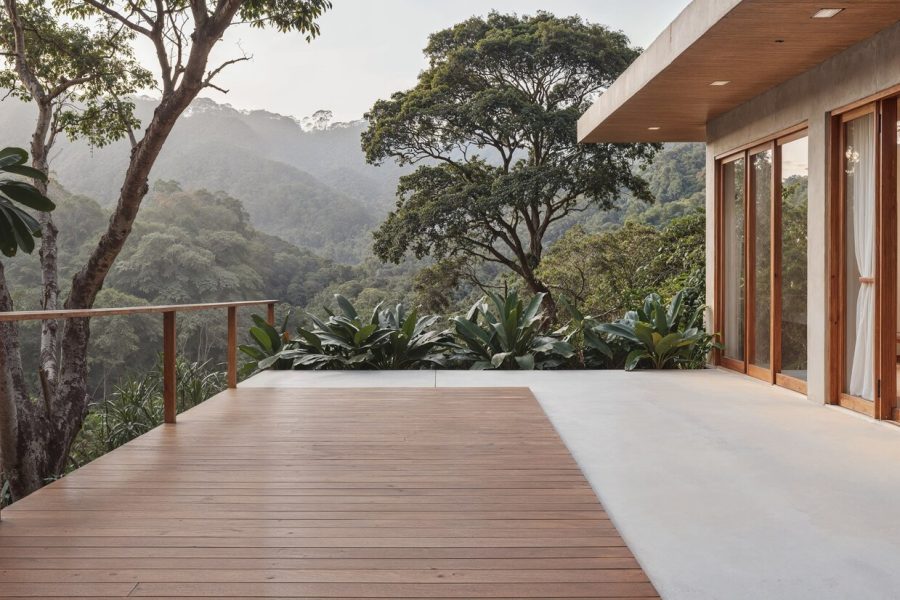
Minimalist doesn’t mean boring, it means deliberate. Every choice on this kind of deck is about removing something rather than adding it, fewer colours, fewer visible parts, fewer things pulling your eye away from the yard itself.
Clip systems do the actual work here, they grab the board from its edge instead of driving a screw through the top, so the surface stays flat and, honestly, the boards last longer too. Since there’s no screw hole for water to creep into over the years. Add a quiet colour and a thin railing on top of that, and the deck just kind of fades into the yard instead of shouting for attention.
- Clean Lines and Open Layouts: open, uninterrupted layouts leave more usable floor space.
- Neutral Colour Palettes: grey and warm brown tones that won’t look trendy-then-dated in five years.
- Hidden Fasteners and Sleek Railings: they aren’t just about looks either, no exposed screw heads also means nothing to stub a bare foot on.
Trend #5: Deck Lighting That Extends Outdoor Living
Half the year in Ontario, the sun’s down before dinner’s even done. A deck without proper lighting just checks out at that point, but the right setup keeps it going. There’s a safety angle too, stairs and level changes are a lot less dicey with a little light showing the way. Add layered lighting and suddenly there’s no rush to head back inside once it cools off.
- Stair Lighting: clear visibility on every step, no groping around in the dark.
- Post Cap Lighting: a quiet, ambient glow along the perimeter.
- Under-Rail Lighting: soft, indirect light that doesn’t blind anyone.
- Recessed Deck Lights: built into the boards themselves for a clean, finished feel.
- Ambient Entertaining Lighting: enough glow to set a mood without floodlighting the yard.
- Safety: way fewer trips back and forth along with less stumbling once the light’s gone.
Trend #6: Privacy-Focused Deck Designs
Some backyards feel like they’re on stage, and that’s exactly what privacy-focused decks are built to fix. A decorative screen or a cedar hedge growing in over time can turn a deck into somewhere you actually want to unwind, not somewhere the whole street can see.
Pergolas help here too, shade up top and a sightline block all in one structure. And when a screen or hedge just won’t cut it, a full fence becomes its own project, one worth planning together with the deck instead of adding on later.
- Decorative Privacy Screens: cut off the sightline without closing the space in completely.
- Cedar Hedges and Natural Privacy: a living wall that only gets better with time.
- Pergolas and Shade Structures: shade and privacy from above, in one move.
- Fence Installation and Maintenance: the answer when nothing else provides enough coverage.
- Planting Emerald Cedar Hedge: still one of the fastest, most reliable green walls out there.
- Hedge Planting: other options exist too, depending on soil, sun, and how much coverage you actually want.
Trend #7: Mixing Decks with Hardscaping
A deck sitting by itself, disconnected from the rest of the yard, is starting to look a little dated. Add an interlock patio at the base of the stairs, or a retaining wall handling a slope the deck never could on its own, and suddenly the whole backyard reads as one space instead of a deck plus whatever’s left over. There’s a cost angle too, interlock at ground level usually runs cheaper per square foot than building out more decking, so mixing materials often stretches a budget further than sticking with just one.
- Interlock Patios: pick up where the deck stairs end, giving people somewhere to spread out without adding another level up top.
- Walkways: tie the deck to the rest of the property without carving a dirt path across the lawn.
- Retaining Walls: solve the grade problems a deck genuinely can’t, holding back slope instead of just sitting on top of it.
- Outdoor Seating Areas: more room to sit without needing to expand the deck’s actual footprint.
- Garden Integration: garden beds worked into the edges soften all that hard material so it doesn’t feel like a parking lot.
- Fire Pit Zones: a separate ground-level hangout spot that doesn’t compete with deck space.
Trend #8: Sustainable and Eco-Friendly Deck Designs
A lot of what gets called “sustainable” on a deck project is really just good building sense wearing a nicer label.
Composite made from recycled plastic and reclaimed wood fibre instead of new material. Grading that sends rainwater somewhere useful instead of straight into a neighbour’s yard. Plants that survive on what actually falls from the sky in Ontario. None of it costs the homeowner extra effort down the line, if anything, it usually means less.
- Sustainable Materials: Wood gets sourced responsibly when it’s used at all, and a lot of the composite on the market skips virgin plastic entirely.
- Rainwater-Conscious Landscaping: grading and plant placement that work with runoff instead of against it.
- Native Plants: Native species handle Ontario’s swings between drought and downpour without needing constant babysitting.
- Long-Lasting Finishes: less product going down means less product needing to be reapplied, and less waste over time.
- Energy-Efficient Outdoor Lighting: LED fixtures do the same job outdoor lighting always did, using a fraction of the power to get there.
Trend #9: Small Backyard Deck Designs That Maximize Space
A tight lot doesn’t rule out a real deck, it just changes how you build one. Skip the full foundation dig with a floating design, and suddenly a small or uneven yard stops being a dealbreaker. Corners get used too, instead of sitting empty the way they do under a straight, full-width deck. And built-in seating solves a problem every small-yard owner runs into eventually: there’s rarely space for both a deck and a proper patio furniture set.
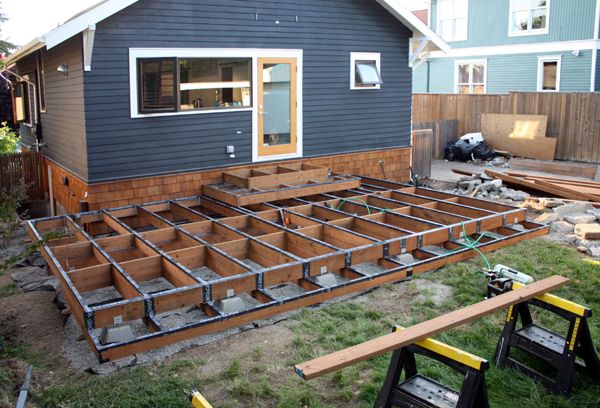
- Floating Decks: no deep foundation means simpler construction, which is exactly why they work so well on awkward or undersized lots.
- Corner Deck Layouts: put property-line space to use that a rectangular deck would otherwise waste.
- Built-In Seating Solutions: seating built right into the structure frees up floor space that furniture would normally eat.
How to Choose the Right Deck Trend for Your Lifestyle
Nowadays, trends is a lot to sort through on your own. Here’s a quick way to match what you actually want out of your backyard to the trend built for it.
| Homeowner Goal | Recommended Deck Trend |
| Hate yearly maintenance | Composite Decking |
| Have a sloped backyard | Multi-Level Decks |
| Love hosting friends and family | Built-In Features (kitchen, fire pit, beverage station) |
| Prefer a clean, modern look | Modern Minimalist Design |
| Evenings matter as much as afternoons | Deck Lighting |
| Value privacy from neighbours | Privacy-Focused Design |
| Want the yard to feel like one space | Mixing Decks with Hardscaping |
| Care about environmental impact | Sustainable and Eco-Friendly Design |
| Working with a small backyard | Small Backyard Deck Design |
What’s Influencing Deck Design Trends in Ontario?
None of these trends are happening in a vacuum. A few bigger shifts are driving all of it at once, and they explain why Ontario backyards look so different than they did even five years ago. Ontario winters push freeze-thaw cycles hard on cheaper materials, with wind chills regularly dropping below -30°C in parts of the province, and homeowners who’ve had to replace a warped or cracked deck once tend not to make the same mistake twice.
There’s a financial angle too. A professionally built deck can return between 65 and 85% of its cost at resale in Ontario, which makes it one of the stronger investments a homeowner can make in their property.
A few things are pushing all of this at once. Backyards have become a genuine lifestyle priority instead of an afterthought, and low-maintenance materials like composite are freeing up weekends that used to go toward sanding and staining. One space now has to do a lot more too, dining, lounging, hosting, sometimes all in the same evening, which is part of why home value keeps coming up in these conversations.
Consult with a Professional to Get Help in Selecting a Deck for Your Property!
With this many directions to choose from, picking the right one for your actual property, not just what looks good online, is usually where homeowners get stuck. What works on a flat, wide-open lot in Bowmanville might not hold up at all on a narrow, sloped lot in Courtice, and a design pulled from a magazine doesn’t always account for Ontario’s climate the way it should.
- A design that actually fits your yard’s slope, size, and sun exposure
- Material recommendations built around what survives Ontario winters, not just what looks good in photos
- A build that balances the trend you want with the budget you actually have
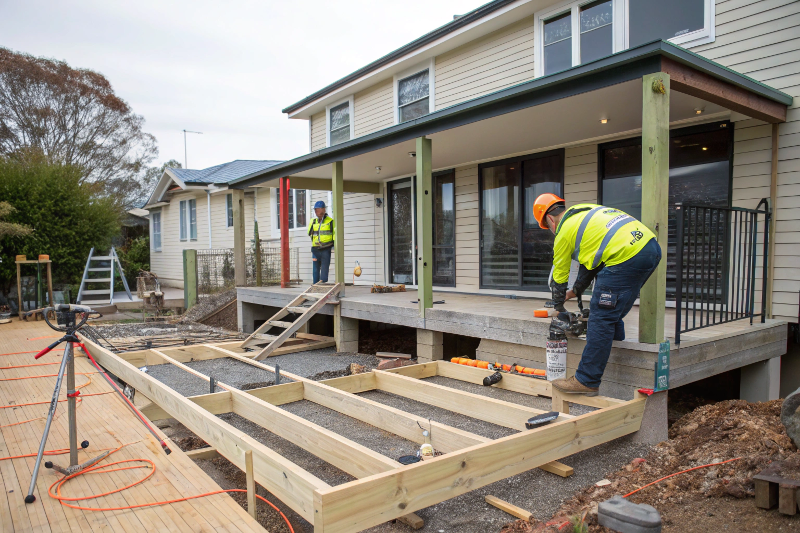
At Allison Bros, we’ve spent 20 years building decks across Durham Region to know which trends hold up and which ones age badly by year three. Our deck construction services cover everything from initial design through final staining and sealing so you get a deck you love actually living it not just in pictures. Get in touch for a free consultation, and we’ll help you land on the trend that actually fits your backyard.
Frequently Asked Questions (FAQs)
Q1. What are the deck trends in 2026?
Multi-level layouts, composite decking, and built-ins like fire pits and outdoor kitchens are the big ones right now. Layered lighting and privacy features are close behind.
Q2. What are the current trends in decking boards?
Capped composite with a more realistic wood grain is where most of the interest is, plus hidden fastener systems for a cleaner surface. Warmer tones are also pushing out the cool greys that were everywhere a few years back.
Q3. What is the best deck material for 2026?
Composite, for most Ontario homeowners, mainly because it shrugs off freeze-thaw cycles without a yearly maintenance routine. Wood still has its fans for a specific look, but it asks for a lot more upkeep to keep it there.
Q4. Is decking still fashionable?
Yes, and arguably more central to how people use their yards than ever. Outdoor living keeps trending up across Ontario, and decks are usually the anchor for all of it.